You have requested several quotes to repaint your interior, and the amounts vary dramatically for an identical surface. Yet all professionals quote a price per square metre. Where do these differences come from? The answer often lies in items that are overlooked in detail, yet weigh heavily on the final budget.
The actual surface to paint does not match the floor area
When you think about repainting a 20 m² room, you might imagine a budget calculated on that size. But a 20 m² room by floor area actually represents 65 to 75 m² of developed surfaces (walls and ceiling). This difference radically changes the quote amount.
In practice, if you want to repaint a 25 m² living room with a ceiling height of 2.50 m, you should count around 80 m² of surfaces to paint once the walls and ceiling are added together. It is this developed surface that serves as the basis for the calculation, not the usable floor area. An essential detail to check when comparing several proposals, as some professionals quote a price per m² without specifying whether it refers to floor area or the actual painted surface.
In Paris, Lyon or Marseille, in Haussmann-style apartments with mouldings and ceiling heights of 3 metres or more, this gap widens even further. A room with mouldings and high ceiling1 can easily double the surface to be treated compared to a standard home.
Surface preparation: the real cost item
Surface preparation often accounts for 50 to 70% of total work time on a painting project2. This is where much of the final cost is determined, long before the first coat of paint is applied.
On a wall in good condition, smooth and clean, the work is limited to washing and light sanding before painting. But as soon as cracks, holes, moisture marks or old wallpaper come into play, preparation time explodes. In an older room with wallpaper, the preparation phase can account for nearly 40% of the total amount.
If you live in Bordeaux, Nantes or Rennes, in an older home with plaster walls weakened over time, restoration can include complete stripping, general scraping, deep filling and several coats of filler. After water damage or in a damp house, prior treatment of moisture3 becomes essential before any finishing work.
Some quotes detail this step item by item (washing, filling, sanding, filler), others include it in a global package. But in all cases, the actual condition of the surface determines the price far more than the paint itself.
Ancillary costs that are often overlooked
Beyond paint and labour, several expenses are added to the quote without always being considered. Site protection, access to high areas, temporary removal of fixtures or end-of-project cleaning can account for around 5 to 15% of the total amount, especially in a detached house with stairs, mezzanine or high rooms.
Site protection includes floor sheeting, furniture protection, masking of door frames, sockets and switches. In a furnished apartment in Lille or Toulouse, where the entire furniture needs to be moved and protected, this item takes time.
If the room has relief elements (mouldings, cornices, exposed beams), sloped ceilings or difficult angles, the work requires more care and extends the duration of the intervention. Similarly, painting a ceiling systematically costs more than a wall, as the working position is uncomfortable and achieving uniform coverage is trickier.
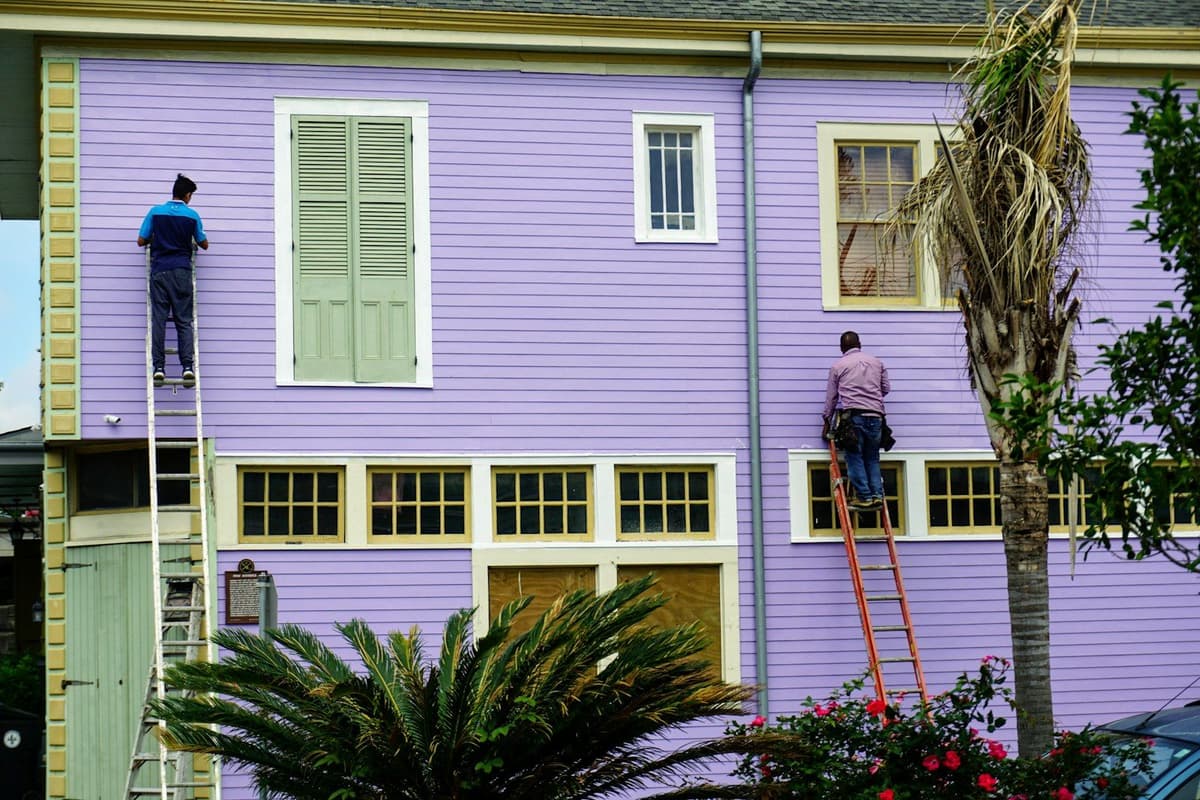
Finally, some projects require the rental of scaffolding or a cherry picker to access high areas, particularly on external facades. This item, often invoiced separately, can add several hundred euros to the overall budget.
Paint type and finish directly influence the price
Materials generally account for 10 to 20% of the overall budget, but this percentage varies enormously depending on the paint range chosen. Standard acrylic paint costs a few euros per m², while technical paint (moisture-resistant, washable, microporous) or decorative paint (marbled effect, patina) can reach €25 per m² for the product alone.
Finish also plays a key role. Matte paint better conceals surface defects and applies quickly, making it the most economical option. On the other hand, a satin or gloss finish requires a perfectly smooth surface and very careful application, which increases both the cost of the paint and the application time.
If you opt for eco-friendly paint with low VOC emissions, the price per litre will be higher, but improved indoor air quality and the durability of the coating often offset the initial investment.
What a seemingly low per m² quote hides
When faced with several quotes, it is tempting to choose the lowest price. But a very attractive per m² rate sometimes masks reduced or incomplete services. Always check what is included in the quoted price: does the quote include site protection, final cleaning, primer, number of finish coats?
Some professionals quote an attractive rate for painting only, assuming the walls are already prepared and ready to paint. Others include all services in their per m² rate. With equivalent services, the difference between three quotes can reach 30 to 40%.
Another point to watch: the VAT rate applied. For a property over two years old, the reduced rate of 10% applies to renovation work, against 20% for a new property or less than two years old. On a €5,000 gross quote, the difference amounts to €500.
Finally, on our platform, all quotes specify the exact scope of work, developed surfaces, the level of preparation planned and the number of coats. The professional has always seen the space to be painted (via photos and videos or during a visit), which ensures that the quote matches the actual condition of your surfaces. Payment is made in two parts: 50% at the start of the project to secure the date and purchase materials, then 50% at the end, once the result has been verified.
Compare quotes methodically to control your budget
To avoid unpleasant surprises, systematically compare at least three quotes by checking the same elements on each: the actual developed surfaces (not just floor area), the level of preparation included (washing, minor filling, complete scraping), the number of paint coats (primer + finish), the references of paints used (brand, range, finish), site protection and final cleaning, and the VAT rate applied.
If a quote is significantly lower than the others without clear explanation, dig deeper to understand what is missing. Conversely, a detailed quote that breaks down each item gives you a clear picture of what you are paying for.
In all cases, prioritise a professional who has seen your walls (via photos, videos or a visit) before quoting. A per m² rate given blind, without knowing the actual condition of the surface, will never be reliable. Our platform systematically requires the submission of photos and videos before validation of any quote, precisely to avoid these approximations and guarantee a final price that matches the reality of the project.

Ready to paint?
Get free quotes from verified local painters in minutes. No commitment.
Sources
External sources open in a new tab.