Starting a painting project in your home may seem straightforward at first, but the final cost can vary considerably. Between a quick refresh and a complete renovation, the budget gap can reach several thousand euros for the same apartment. So what are the real factors that push costs up or down, and how can you anticipate these differences to better plan your project budget?
Wall condition: the weightiest factor
Preparation work can represent up to 50 % of the quote in some painting projects. It is often the most decisive element of the final cost. A wall that is already smooth, in good condition and simply needs refreshing will require only light cleaning and two coats of paint. By contrast, a surface damaged by cracks, plaster chips, moisture or old wallpaper to remove will keep the painter occupied for hours before the first coat even goes on.
In a Parisian or Lyon apartment dating from the 1980s or 1990s, for example, it is not uncommon to encounter slightly damaged walls requiring filling and sanding. These preparation works add time and, consequently, cost. Conversely, in a new construction in Toulouse or Nantes, new plasterboard will require little preparation, which significantly reduces the budget.
Total surface area to paint: calculate correctly to avoid surprises
Many homeowners think in terms of floor square metres, but a room of 20 m² of floor space represents approximately 60 to 80 m² of surfaces to paint (walls + ceiling). It is this actual wall and ceiling surface that serves as the basis for the quote calculation. The higher the ceiling height, the greater the surface area to paint, especially in Haussmann apartments in Paris or in certain period properties in the Bordeaux region.
This common confusion between living space and paintable surface can create significant gaps between an owner's initial estimate and the quote received. It is therefore useful to measure not only the floor area, but also the wall height and the number of openings (doors, windows) which slightly reduce the paintable surface.
Paint type and finish: a choice with a price
Not all paints are equal, and it is not just a question of brand. Standard acrylic paint suits most rooms and remains economical. But in a bathroom in Marseille or a kitchen in Strasbourg, moisture-resistant paint that resists splashing should be prioritised, often at a slightly higher cost. Similarly, environmentally friendly paint with low VOC content, increasingly requested for children's bedrooms or sensitive properties, generally commands a higher price.
The finish chosen also plays a role. A matte finish will be easier to apply and will better cover minor imperfections, while a satin or gloss finish will require a perfectly smooth surface and several coats, increasing work time and therefore cost.
Project complexity: height, access and technical constraints
The main factors influencing the price include the nature of the substrate, specific services (undercoats, high-end finishes) and technical constraints (high-level work or difficult access). Painting a ceiling in a living room with a 3.5 metre ceiling height requires more equipment and precautions than a standard 2.5 metre ceiling.
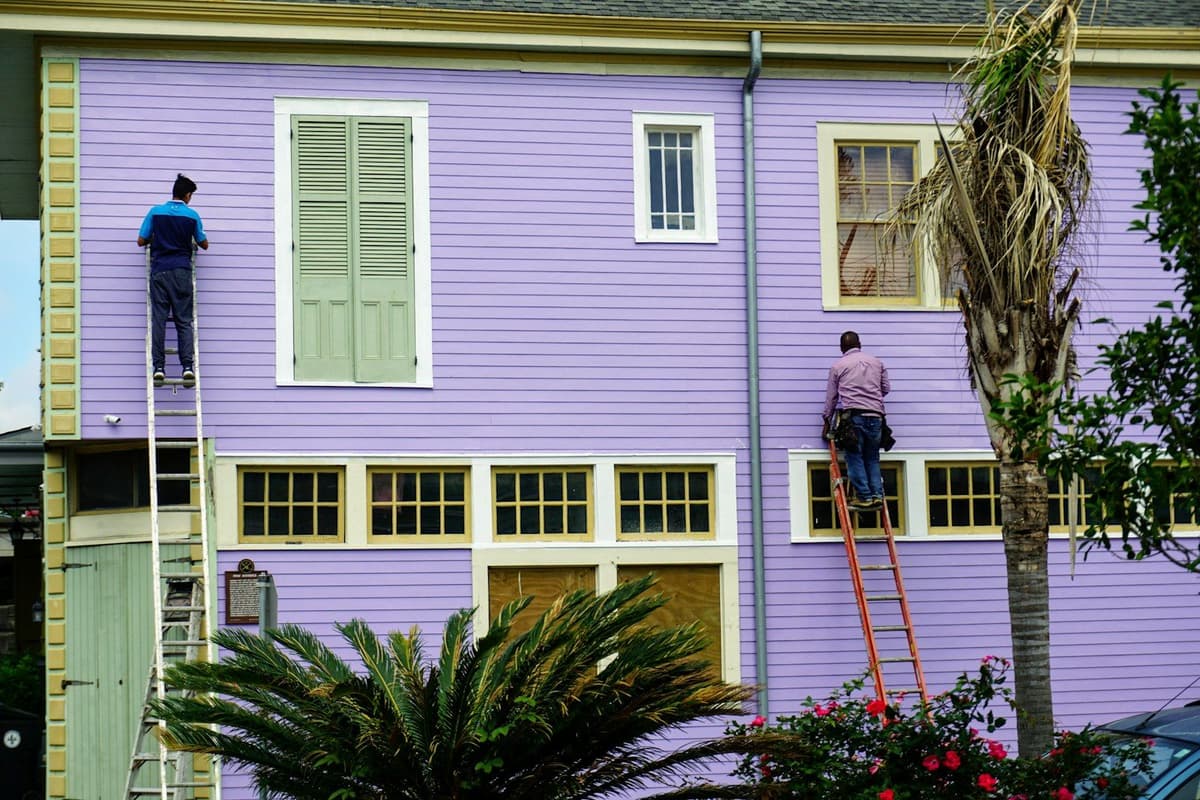
Similarly, in a multi-storey house in Rennes or Lille, painting a tall stairwell requires scaffolding or specific ladders, which extends set-up time and increases cost. Difficult-to-access spaces, such as rooms cluttered with heavy furniture or converted lofts with sloping ceilings, also require more protection and handling time.
Region and local context: notable price variations
Painter rates vary from one region to another. Prices vary by approximately ±15 % depending on the region (Île-de-France +15 %, rural areas -10 %). In Paris and the immediate suburbs, travel costs, parking and labour are higher than in rural areas in Normandy or Brittany. This surcharge also reflects strong demand for work in major urban areas.
Conversely, in medium-sized cities such as Angers, Clermont-Ferrand or Perpignan, rates often remain more affordable while offering quality services. It is therefore useful to compare several quotes while taking into account the local context and average rates practised in your area.
Ancillary costs: protection, cleaning and equipment removal
Some ancillary costs concern home protection, access to high areas, temporary equipment removal or site clean-up; they can represent approximately 5 to 15 % of the total amount. These items are sometimes overlooked in the initial estimate, but they are an integral part of the project.
If you wish to repaint a room that is still furnished, the painter will need to protect the floors, furniture and fixed elements such as radiators or electrical outlets. In some cases, temporary removal of light fixtures, curtains or wall-mounted shelves will be needed, which adds work time.
Comparing quotes carefully to control your budget
To avoid unpleasant surprises, it is essential to request several detailed quotes. For equivalent work, the difference between 3 quotes can reach 30 to 40 %. Each quote should specify the exact surface area to paint, the type of paint used (brand and reference), the number of coats planned, the preparation work included and any ancillary costs.
On our platform, all professionals presented are properly registered as self-employed or have a company registered with a valid SIRET number. This verification is carried out beforehand to guarantee that you work with painters in good standing. Moreover, the quote is always based on a real assessment of your space: the professional must have seen the surfaces to paint, either through detailed photos and videos that you send, or during an on-site visit. Both approaches are equivalent and make it possible to establish a precise quote, tailored to the actual condition of your walls and ceilings.
Finally, payment is organised in two stages: 50 % at the start of work to reserve the date and purchase materials, then 50 % at the end, once you have verified the final result. This mechanism protects you while ensuring the painter receives a serious commitment from you. All project details (surfaces, paints, services) are visible online to you, to the professional and to the platform, guaranteeing transparency and traceability at each stage of the project.
Ready to paint?
Get free quotes from verified local painters in minutes. No commitment.